DNS
The Domain Name System or DNS for short typically correlates domain names with an IP address.
$ dig www.google.com

; <<>> DiG 9.10.6 <<>> www.google.com
;; global options: +cmd
;; Got answer:
;; ->>HEADER<<- opcode: QUERY, status: NOERROR, id: 44994
;; flags: qr rd ra; QUERY: 1, ANSWER: 1, AUTHORITY: 0, ADDITIONAL: 1

;; OPT PSEUDOSECTION:
; EDNS: version: 0, flags:; udp: 1232
;; QUESTION SECTION:
;www.google.com.                        IN      A

;; ANSWER SECTION:
www.google.com.         94      IN      A       142.250.217.100

;; Query time: 9 msec
;; SERVER: 192.168.0.1#53(192.168.0.1)
;; WHEN: Sun Dec 05 15:27:12 PST 2021
;; MSG SIZE  rcvd: 59
In this example, we are querying for an IPv4 address of the domain name www.google.com and our DNS resolver returns the IP 142.250.217.100.
;; ANSWER SECTION:
www.google.com.         94      IN      A       142.250.217.100
Reverse DNS
A DNS PTR record does the exact opposite of this. They are known as reverse DNS lookups where we query for an IP address and are expecting a domain name result.
Using dig, we use the -x flag.
$ dig -x 142.250.217.100
; <<>> DiG 9.10.6 <<>> -x 142.250.217.100
;; global options: +cmd
;; Got answer:
;; ->>HEADER<<- opcode: QUERY, status: NOERROR, id: 904
;; flags: qr rd ra; QUERY: 1, ANSWER: 1, AUTHORITY: 0, ADDITIONAL: 1

;; OPT PSEUDOSECTION:
; EDNS: version: 0, flags:; udp: 1232
;; QUESTION SECTION:
;100.217.250.142.in-addr.arpa.  IN      PTR

;; ANSWER SECTION:
100.217.250.142.in-addr.arpa. 51175 IN  PTR     sea09s30-in-f4.1e100.net.

;; Query time: 6 msec
;; SERVER: 192.168.0.1#53(192.168.0.1)
;; WHEN: Sun Dec 05 15:33:11 PST 2021
;; MSG SIZE  rcvd: 95
The result looks a little funny. sea09s30-in-f4.1e100.net is the domain name returned. This does not look related to Google.
;; ANSWER SECTION:
100.217.250.142.in-addr.arpa. 51175 IN  PTR     sea09s30-in-f4.1e100.net.
Also, what is this 100.217.250.142.in-addr.arpa? I thought we queried for 142.250.217.100!
DNS PTR Records
DNS PTR records are stored under the IP address reversed and with .in-addr.arpa added to the end. In our case, we reverse 142.250.217.100 and get 100.217.250.142. Appending .in-addr.arpa gets us 100.217.250.142.in-addr.arpa.
Why .in-addr.arpa?
Because PTR records are stored within the .arpa top-level domainin DNS. .arpa was the first top-level domain name defined for the internet and comes from ARPANET (Advanced Research Projects Agency Net).
IPv6 PTR records still exist in the .arpa namespace but are stored using the suffix .ip6.arpa instead of .in-addr.arpa.
So what is sea09s30-in-f4.1e100.net?
According to this support post, 1e100.net is a Google owned domain name used to identify servers in their network. The trivia fact is that 1e100 is the scientific notation for 1 googol.
What are PTR records used for?
Anti-spam
Certain email anti-spam filters use PTR records to validate domain names of email addresses. This helps them verify whether or not the associated IP addresses are used by the legitimate email servers.
Human readability
System logs typically record IP addresses. To help an operator with troubleshooting, reverse DNS lookups can help convert these into domain names that are more human-readable.
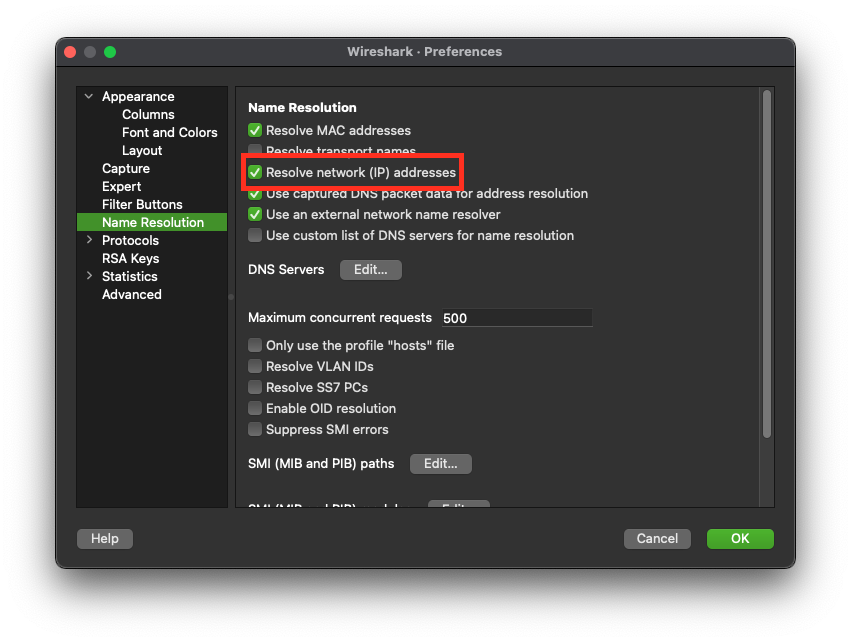
In WireShark, you can resolve network ip addresses using the Resolve network (IP) addresses option in Preferences to make it much easier to see where traffic is coming from.